Dried Prunes
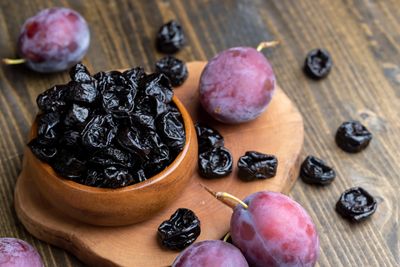
Introduction
At Petrichor Foods EU, we believe every fruit has its own story. Prunes, with their deep flavor and natural sweetness, carry centuries of tradition from East Europe to the Americas. Beyond being a healthy snack, they are valued for their versatility. From bakeries and confectioneries to modern superfood mixes.
Our role is to connect this heritage with today’s markets by ensuring that every prune we supply is handled with care, traceability, and scientific precision.
History and Distribution
Plums are members of the stone fruit family, growing on deciduous trees that reach about 4–5 meters in height, with dense crowns. Over 2,000 varieties exist worldwide, including plums, mirabelles, and greengages, which are often grouped under the broader category of prunes. Due to hybridization, distinctions between plums and prunes are sometimes blurred.
For dried prune production, only specific varieties are suitable—those that resist fermentation during drying. Two major types are recognized: the elongated, slightly tart “Italian” prune and the round, sweeter “French” prune, the most famous being the d’Agen variety, cultivated widely in France, the United States, and South America.
Prunes are believed to have originated in Persia, later spreading through Asia Minor and Greece into Europe. In 1865, Louis Pellier introduced the French prune to California, laying the foundation for today’s leading U.S. prune industry. Modern production centers include California, France, Chile, Argentina, and Bulgaria.
Prunes are enjoyed both as a snack and as a versatile ingredient in bakery, confectionery, breakfast cereals, and dried fruit blends. Traditionally, they have also been valued for their natural digestive benefits.
Cultivation
On modern farms, plum trees are planted in straight rows. They typically begin bearing fruit 4–6 years after planting and remain productive until about 30 years of age. Mature trees yield 70–140 kg of fresh plums annually.
To produce 1 kilogram of dried prunes, approximately 3 kilograms of fresh plums are required.
Harvest
Harvesting takes place from mid-August to early October in the Northern Hemisphere and around February in the Southern Hemisphere.
Fruit quality depends heavily on proper ripeness at harvest. Trees are shaken mechanically, allowing only fully ripe plums to fall into nets. The fruit is then collected into large wooden bins and transported promptly for processing.
Processing
Fresh plums are placed on conveyor belts and dried in ovens at around 78 °C (172 °F) for 16–18 hours, reducing moisture to about 15% and transforming them into prunes. The dried fruit is then graded by size using sieves with varying hole diameters.
At this stage, prunes can be stored safely for extended periods due to their low moisture content. However, for further processing, they are often rehydrated to 20–30% moisture with hot steam at about 90 °C (194 °F). This softens the fruit, making it easier to remove the pits.
Two main pitting technologies are used:
- Ashlock method – A spike pushes the pit through, leaving the prune largely intact with just a small hole.
- Elliott method – The pit is squeezed out, causing the fruit to lose some of its shape.
Prunes may be treated with potassium sorbate (a preservative) to extend shelf life. With proper storage, prunes remain stable for up to one year.
Nutrition Facts (per 100 g of dried apricots)
- Energy: 256 kcal (1,069 kJ)
- Fat: 0.5 g
- Protein: 1.9 g
- Carbohydrates: 59.5 g
- Minerals: 1.7 g
- Vitamins: ~3.7 mg
Grading
Prunes are graded by size before pitting, measured by the number of fruits per pound (453.6 g). The fewer prunes per pound, the larger the fruit.
- 10/20 (President grade) – Largest, rarest (10–20 prunes per pound)
- 20/30
- 30/40
- 40/50
- 60/70
- 70/80
- 80/90
- 90/100 – Smallest, mainly used for industrial purposes
Large prunes are typically selected for consumer packaging, while smaller ones are directed toward industrial applications.